
UFC Betting UK: Data-Led Odds and Market Strategies (2026)
 Available in US
Table of Contents
- Core Advantages for the UK UFC Bettor
- Is Betting on UFC Legal in the UK in 2026
- UFC Bet Types Explained for UK Punters
- How Fractional Odds Work in UFC Betting
- UK Regulation 2025–2026: Affordability, Stake Limits, Tax
- UFC Fight Data UK Punters Should Know
- UFC Method & Distance Value Calculator
- Best Practices for Choosing a UK UFC Sportsbook
- Live and In-Play UFC Betting
- UFC in the UK: Events, Audience, Media Rights
- Responsible Gambling and the Black Market Risk
- Pre-Bet Checklist for UK UFC Punters
- What Eight Years at the Octagon Cageside Taught Me About UK Punting

Data-led UFC odds analysis built for UK punters.
I have been pricing UFC cards for British punters since the days when you had to ring a high street shop to get a method-of-victory line on a Cage Warriors prelim. Eight years on, the questions I get from new punters have barely changed — what does 5/3 actually pay, why did the line move at 11 pm on Friday, can I really keep my winnings without HMRC sniffing around. What has changed is the regulatory furniture sitting around those questions, and the volume of decent data we can lean on.
Most UK pages about UFC betting read like a Saturday morning car advert — bright, loud, light on substance. They tell you what a moneyline is, drop a link to a welcome bonus, and leave you to it. That is fine if you are picking out a beer. It is not fine if you are about to wager £40 of your own money on a featherweight you watched once on Fight Pass at half two in the morning.
This guide is built on different scaffolding. The UK Gambling Commission reported a record £16.8 billion in industry gross gambling yield for the financial year running April 2024 to March 2025, with the remote casino, betting and bingo sector growing 13.1 per cent year on year. The UK is the eleventh biggest sports betting market in the world, and ours is one of the few that has both heavy MMA fan density and a tightly regulated set of rules wrapping every bet. So I will keep the numbers honest, the regulation current, and the strategy frames grounded in things I have actually watched move a line.
What follows is the walkthrough I wish someone had handed me when I started — bet types you will use, the maths under the prices, the new affordability rules that catch most casuals off guard, fight data by division, how live markets behave when a fighter blinks, and the responsibility piece that frankly most operators bury in their footer.
Core Advantages for the UK UFC Bettor
- Betting on UFC is legal in the UK only with a UKGC-licensed sportsbook — verify the licence number in the site footer against the Commission’s public register before depositing.
- UFC favourites win 72 per cent of fights and underdogs 32 per cent, but 51 per cent win rates near pick’em prices mean the toss-ups are genuinely 50-50 — chasing safety in tight spots is not value.
- Financial vulnerability checks now trigger at £150 net deposits over thirty days, with 7 per cent of accounts affected in practice. They do not affect your credit score.
- Remote Gaming Duty rises from 21 to 40 per cent in April 2026 — UFC odds will tighten, promotional terms will firm up, your winnings stay tax-free.
- Stay inside the UKGC-licensed market. The £16.6 billion UK black market offers no recourse, no GamStop and no protection.
Is Betting on UFC Legal in the UK in 2026
A reader once messaged me at 2 am, mid-card on a UFC Vegas night, asking if it was illegal that he had just placed his first ever bet. He genuinely was not sure. For a country where you can legally back a fly crawling up a window pane, the rules around sports betting are surprisingly murky in people’s heads. Let me clear it up in one line. Betting on UFC fights is legal in the UK, provided the sportsbook you are using holds a UK Gambling Commission licence. That is the entire test.
The reason it matters is consumer protection. A licensed sportsbook is contractually bound to ringfence your funds, settle disputes through an approved alternative dispute resolution body, run identity and age checks, enforce self-exclusion through GamStop, and follow strict rules on advertising. An unlicensed offshore site offers none of that. If they decide your winning Volkanovski bet was suspicious, you have no meaningful recourse. The remote casino, betting and bingo sector alone generated £7.8 billion in gross gambling yield in the year to March 2025 — the regulated UK market is enormous, well staffed, and you have no good reason to bet outside it.
What the UK Gambling Commission Does
The UKGC is the statutory regulator. It issues operating licences, audits compliance, fines or strips licences from operators that breach rules, and publishes the data that lets people like me write guides like this. When Andrew Rhodes, the regulator’s chief executive, addressed industry leaders this past year, he reported that total gross gambling yield was at its highest ever level at £15.6 billion and that participation in gambling had remained stable at 48 per cent — those headline numbers shape the policy choices that affect your account.
The Commission’s reach is broader than most punters realise. It oversees marketing rules, customer due diligence standards, anti-money-laundering obligations, problem-gambling tooling, and the technical reliability of betting platforms. The number of criminal cases the Commission is now bringing has gone up roughly 300 per cent year on year, which tells you both that enforcement has teeth and that the unlicensed corner of the market is bigger than it used to be.
What a UKGC Licence Tells You at a Glance
You can verify any UK-licensed sportsbook in about thirty seconds. The Commission runs a public register of every account number it has issued — the licensee’s name, their trading names, the licences they hold and the conditions attached. A legitimate UK UFC sportsbook will display its licence number and account number in the site footer, usually alongside the words “licensed and regulated by the UK Gambling Commission”. A site that does not show this prominently, or shows a Curacao or Malta licence number on a domain pitched at UK punters, is operating outside the British framework. That is your first and biggest filter — and we go deeper on verification in our piece on UK UFC betting regulation 2025–2026.
UFC Bet Types Explained for UK Punters
The first UFC bet I ever placed was a moneyline on Forrest Griffin. I had no idea what method of victory meant, I thought “round betting” was when you bet on whether the fight finished a round, and I was vaguely convinced an “over/under 2.5” had something to do with goals. I won the bet, which was the worst possible outcome — I spent the next two years assuming I knew what I was doing. Most new punters do exactly the same thing. So let me walk you through the markets in roughly the order you will encounter them on a UK card, with enough context that you can choose between them rather than guessing.

Moneyline / Match Winner
The simplest market on any fight card. You back one fighter to have their hand raised — knockout, submission, decision, disqualification of the opponent, all count. Stronger favourites sit at shorter odds, underdogs at longer ones. Favourites win UFC fights roughly 72 per cent of the time, which sounds like easy money until you do the maths on the implied prices.
Method of Victory
This is where MMA starts to get interesting. You pick how the fight ends — KO/TKO, submission, or decision. UFC’s overall finish rate sits at around 53 per cent, with knockouts and TKOs at 33.3 per cent and submissions at 19.7 per cent. Method-of-victory pricing rewards punters who read style matchups properly. A wrestler-heavy welterweight backing a striker into the cage all night is a different bet to a flyweight title fight pencilled in for five rounds. We go deep on this in the dedicated UFC bet types reference.
What counts as a finish — A KO is decided by the strike that ends the fight. A TKO is called by the referee, doctor or corner when a fighter can no longer intelligently defend. A submission is any tap. Anything else — decision, DQ, no contest — falls outside the finish category, and books settle those market by market.
Round Betting
You back the fight to end in a specific round, or a “round group” such as rounds 1 to 2 or rounds 3 to 5. Round betting is a high-margin market because the universe of outcomes is wide. Prices look generous, particularly at heavyweight where two-thirds of fights end inside the distance.
Over/Under Total Rounds
Pick whether the fight lasts more or fewer rounds than the line, usually at half-round increments. With around 55 per cent of UFC fights now going the full distance, over/under is one of the better volume markets for punters who watch a lot of tape. The half-round line removes the chance of a push, which is why books price it slightly heavier.
Prop and Specials Markets: A High-Level Tour
Beyond the core markets sit the prop and specials shelves — fight to go the distance, knockdowns, round-one takedowns, performance-of-the-night specials. Books trade these less and the public bets them less, which is why they are softer in pricing terms and where strong style reads find value.
Outright and Futures Markets
Long-term wagers — who holds the lightweight title at the end of 2026, who is next challenger at heavyweight. Liquidity is thinner, line movement is sharper around announcements, the variance is brutal. They reward punters who have a structural view of a division rather than a hot take on Saturday’s main event.
Parlays and Accumulators
An accumulator combines two or more selections into a single bet where every leg must win. UK punters love a fight night acca. Even with favourites winning 72 per cent of fights, a four-leg accumulator of favourites lands a touch above one time in four. The advertised massive payout is built on the slips that lose.
✓ Do
- Stick to one or two markets per fight until you have learned how they price.
- Compare the same market across two licensed UK books before placing.
- Treat method of victory as a style read, not a hunch.
✗ Don’t
- Add a method-of-victory leg to an acca just because the price boosted the slip.
- Confuse round betting with over/under — they settle on different events.
- Bet outright futures with money you would mind being tied up for a year.
How Fractional Odds Work in UFC Betting
An American friend once asked me, with genuine confusion, why our books “do fractions like a children’s textbook” instead of decimals. The honest answer is history — British bookmaking grew up on racecourses long before computer screens and the fractions stuck. The good news is once they click, fractions are arguably the most intuitive odds format on the planet. A price tells you, very directly, how much you stand to win against your stake.
Reading 5/3, 11/10 and Other Fractions
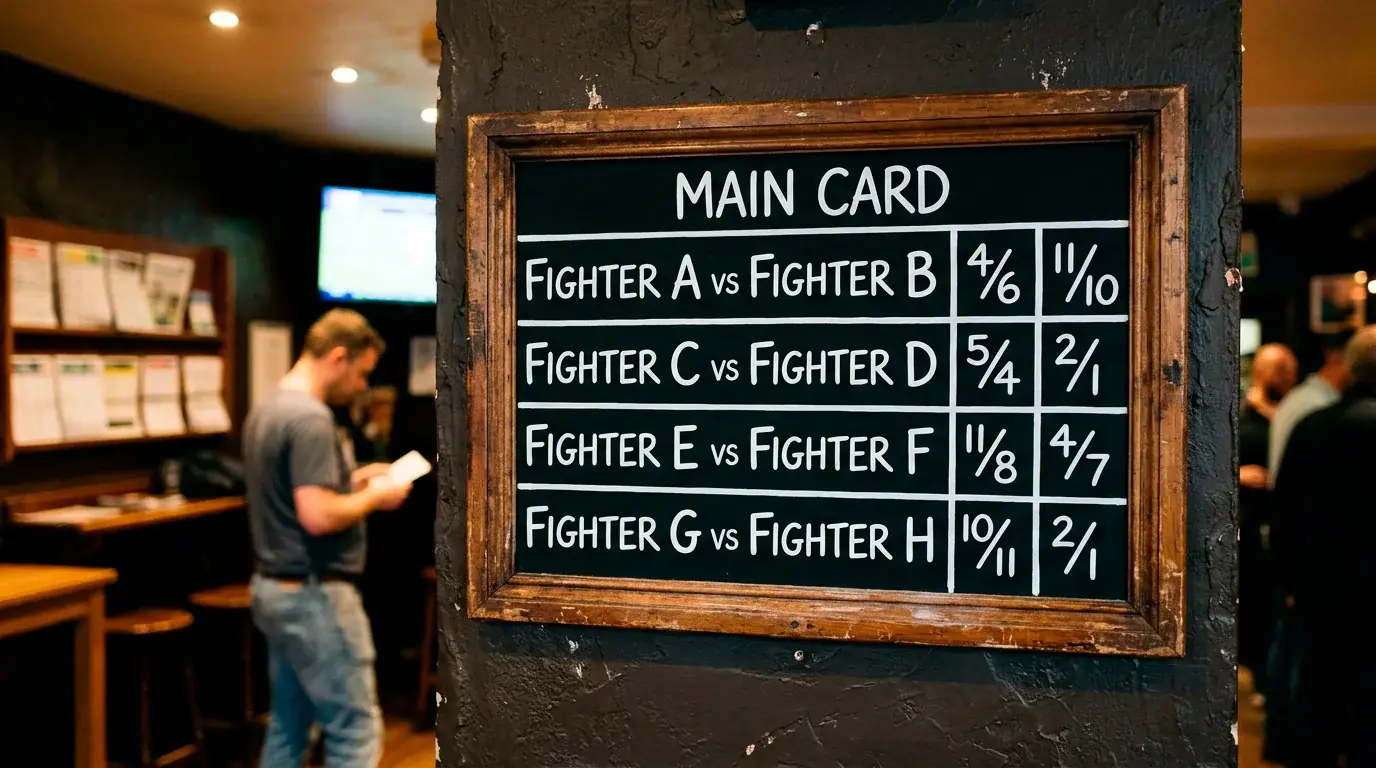
A fractional price like 5/3 reads as “five to three”. For every three units you stake, you win five units in profit if the bet lands. A £3 stake at 5/3 returns £5 profit on top of your £3 stake — £8 in total. The number on the left is your winnings, the number on the right is what you put down.
Some prices look weird the first time. 11/10 is short odds — an £11 profit on every £10 staked. 4/6 is “odds-on” — you stake six to win four, which is the book telling you the fighter is a clear favourite. Anything where the right-hand number is bigger than the left is odds-on. The historical UK convention is to write the closest whole-number fraction, which is why you see 11/10 and not 1.1/1.
Implied Probability
Every odds price implies a probability. The formula is denominator divided by (denominator plus numerator). So 5/3 implies 3 ÷ 8 = 37.5 per cent. 4/6 implies 6 ÷ 10 = 60 per cent. 2/1 implies 33.3 per cent.
Walking the calculation on a real-style line
Suppose a UFC welterweight is priced at 4/6 to win on the moneyline.
Step one — implied probability: 6 ÷ (6 + 4) = 0.60, or 60 per cent.
Step two — payout on a £15 stake: profit = £15 × (4 ÷ 6) = £10. Total returns = £25.
Step three — compare to your own probability estimate. If you think the fighter is more like a 70 per cent favourite, the 60 per cent implied price is value. If you think they are more like 55 per cent, the price is short and you should pass.
Long-running UFC odds analysis bears this out in practice. Fights priced between -400 and -900, the heaviest favourites, win at an 88 to 93 per cent clip since 2013, while fights priced from +100 to -122, near pick’em territory, return a win rate of just 51 per cent. The market is broadly efficient at the extremes and noisier in the middle, which is exactly where most value-hunters live.
Why Closing Lines Matter for Punters
The closing line is the price the moment betting closes — main events typically hit their closing price about ten or fifteen minutes before the walkouts. If you consistently beat the closing line, getting 11/8 on a fighter who closes at 6/4, the market has on average moved towards your view by the time it shuts. Over hundreds of bets, beating the closing line is the single best statistical predictor that a punter is making profitable decisions.
Fractional vs Decimal vs American Formats
Most UK sites let you toggle. Decimal odds of 2.50 equal 6/4 in fractions, or +150 in American. Decimal odds of 1.67 equal 4/6, or -150 American. The maths is identical — only the presentation changes. American odds turn up on US-facing previews and cross-border streams, and confusion is most common when a British punter reads a US tipster’s “Edwards -150” and assumes it is a price they cannot get. They can — it is just 4/6 in another suit. The deeper mechanics sit in our UFC fractional odds guide.
UK Regulation 2025–2026: Affordability, Stake Limits, Tax
A regular reader rang me in March panicked — his sportsbook had emailed him asking for three months of bank statements after a £180 deposit on a UFC London card. He thought it was a scam. It was not. It was a financial vulnerability check, and the rules around them have moved more in the last eighteen months than in the previous decade. If you bet on UFC in the UK and you do not understand what is changing in 2025 and 2026, you will at some point hit a wall you did not see coming.

Affordability and Financial Vulnerability Checks
Financial vulnerability checks, or FVCs, are the Commission’s mechanism for spotting punters at risk of harm before harm lands. The framework went live with a £500 net-deposit threshold over thirty days from late August 2024. From 28 February 2025 the threshold dropped to £150 — a non-trivial number for anyone who bets on more than one card a month.
Hit the £150 net-deposit number and your sportsbook is permitted to run a light-touch credit reference check using public information. This is not a hard credit search and does not affect your credit score. What the Commission discovered, slightly to its own surprise, was that real-world implementation caught 7 per cent of accounts under the original framework, not the 3 per cent it had modelled. The senior policy research team have stated they will continue to monitor the impact at the lower £150 threshold — translating that out of regulator-speak, the rules are bedding in and may move again.
Of the 44.2 million withdrawal transactions processed between June and September 2024, 96.3 per cent were paid out automatically, 3.5 per cent within 24 hours, and only 0.1 per cent took longer than 48 hours. The system, in aggregate, works fast — the friction is concentrated on a small slice of accounts.
Stake Limits and Age-Based Caps
The UK introduced a £5 maximum stake on online slots from 9 April 2025, and a £2 limit for players aged 18 to 24 from 21 May 2025. Slots are not UFC betting, so neither rule directly caps a bet on a fight — but the wider compliance posture filters through to how aggressively books market sports promos and how they treat heavy-traffic accounts.
Remote Gaming Duty Rising to 40 per cent in April 2026
This one matters. The November 2025 Budget confirmed Remote Gaming Duty will rise from 21 per cent to 40 per cent from April 2026, with a new remote betting duty rate of 25 per cent following in April 2027. Betting and gaming duties were already projected to bring in around £4 billion in 2025-26 — roughly 0.3 per cent of total government receipts, the equivalent of £140 per household.
The industry’s response has been blunt. Grainne Hurst, chief executive of the Betting and Gaming Council, told industry press: “It is now clear these further tax rises are a direct threat to British jobs and economic growth.” For punters, the impact is indirect but real. Operators absorbing higher duty rates recover the margin from somewhere — wider overround on individual prices, fewer enhanced specials, tighter promotional terms. Our deep dive on the regulatory landscape covers the timing and operator mechanics in detail.
Why Winnings Stay Tax-Free for Punters
UK gambling winnings are not taxable income for the punter. They never have been under modern HMRC policy. The tax sits with the operator — that is what Remote Gaming Duty and General Betting Duty are. You do not declare a UFC payout on your self-assessment, you do not owe capital gains, and you do not need to keep receipts for a winning bet. That remains true even when the duty rate rises in 2026. The operator pays more. You do not pay anything new.
UFC Fight Data UK Punters Should Know
Most punters bet UFC on vibes. “Strickland is so weird he might catch DDP.” “Pereira always finds the leg kick.” I have done it. The trouble is the prices are set by people who absolutely do not bet on vibes — they have models, weight-class priors, ten years of cage data. Before you put a stake down, share their reference points.
UFC Method & Distance Value Calculator
Heavyweight finishes ~66% of fights; flyweight mostly goes the distance. Method and over/under prices should reflect that – but they are often soft. Pick a division, enter the fractional odds, and see where the value sits against the divisional baseline.
How this works: UFC finish rates vary sharply by weight class – heavyweight ends roughly 66% of fights inside the distance, while flyweight and bantamweight are decision-heavy. This calculator loads a divisional baseline for KO/TKO, submission and decision from long-run UFC data, then compares it to the price on offer. Implied probability from a fractional price a/b = b / (a + b); fair odds work back from the baseline chance. Value = (baseline chance × decimal odds) − 1: positive means the market is paying more than the division’s history suggests. The baseline is a starting anchor, not the answer – a specific matchup (a grappler vs a knockout artist, a five-round title fight, a fighter on a short-notice weight cut) shifts the real number, so treat this as the reference the price should be measured against, then adjust for the tape. The percentages are long-run averages across many fights, never a guarantee for one bout. Not financial advice. 18+ – GamStop and BeGambleAware are protection routes; National Gambling Helpline 0808 8020 133.

72%
UFC favourites’ win rate in 2024
32%
Underdogs winning across 2023-2024
53%
Overall UFC finish rate
55%
UFC fights going the distance in 2024
Favourite vs Underdog Win Rates
UFC favourites won 72 per cent of their fights in 2024. That tells you backing the chalk on every card will return a high win rate. What it does not tell you is whether it is profitable. At an average favourite price of 4/6, you need to win 60 per cent of bets just to break even after the book’s overround.
The flip side is interesting. Underdogs in UFC won approximately 32 per cent of fights across 2023 and 2024 — dramatically higher than in most major sports, reflecting MMA’s variance. One well-timed elbow ends an entire fight. A disciplined underdog approach can produce strong returns, but only with selective filtering. The strategy frame sits in our piece on UFC weight class finish rates.
Finish Rates Across the Octagon
UFC’s overall finish rate is 53 per cent — KO/TKO at 33.3 per cent and submissions at 19.7 per cent. The other 47 per cent goes to the judges. Across 2024, decisions hit a record share — about 55 per cent of fights went the distance. That trend tightens “over the distance” prices and widens the gap between divisions where finishes are common and where they are not.
Weight-Class Differences That Move the Line
Heavyweight is the outlier. Roughly 66 per cent of UFC heavyweight fights end inside the distance, and only about 28.6 per cent reach the scorecards — the lowest decision rate of any division. Backing the underdog at heavyweight is a different proposition to backing the underdog at flyweight. Heavy hands and modest gas tanks mean any heavyweight is a punch away from winning or losing.
At the opposite end, flyweight and bantamweight host the slickest grapplers and the most cardio-driven game plans. Decisions dominate. Method-of-victory prices on a flyweight scrap should never offer the same KO odds you would find at heavyweight, but inexperienced models occasionally still price them too generously. Lightweight sits in the middle — varied styles and a liquid market.
Heavyweight
~66% finish rate. Lowest decision rate. KO-heavy.
Light Heavyweight
Above average KO rate. Decisions tighten in title fights.
Middleweight
Mixed. Style matchups dominate finish probability.
Welterweight
Closer to UFC average. Wrestling depth tilts to decisions.
Lightweight
Near UFC average finish rate. Liquid market, sharp lines.
Featherweight
Submissions and TKOs near parity. Cardio matters late.
Bantamweight
Decision-heavy. Volume strikers dominate scorecards.
Flyweight
Highest decision rate. Method markets often soft on KO side.
One last reference — the price-bucket data. UFC moneylines between -400 and -900 deliver an 88 to 93 per cent win rate, while pick’em prices from +100 to -122 hover around 51 per cent. Read that twice. Hard favourites mostly win. Toss-ups are genuinely tosses. There is no special insight at -130 that does not exist at +110.
Best Practices for Choosing a UK UFC Sportsbook
Picking a sportsbook is a bit like picking a barber. Most of them can do the job, a few will quietly ruin your week, and the differences only matter once you have been to enough of them to compare. There is no single “best UK UFC sportsbook” — the question is which set of features matters most to how you bet. I will not name names, because frankly the league table moves every quarter. What I can give you is the checklist I use myself.
Licence and Domain Checks
The licence is non-negotiable. Footer text should read “licensed and regulated by the UK Gambling Commission” with a licence number you can paste into the Commission’s public register and get a match. The domain should be the operator’s official UK-facing one. A Curacao-licensed site that does not appear on the UK register is not. This is the part most casual punters skip, and it is the part that, when it goes wrong, costs the most.
Market Depth for UFC
Run a quick depth test. Open the sportsbook the Tuesday before a UFC card and count the markets per fight. A good UK book offers moneyline, method of victory across the main split-outs, total rounds with at least one half-round line, exact round in groups, and a bet builder. A great one adds fighter-specific props — strikes landed, knockdowns, takedowns — across the main card and ideally the prelims. Depth is the best proxy for how seriously a book trades UFC.
Payouts, Withdrawals and Limits
96.3 per cent of UK gambling withdrawals process automatically. That number is the benchmark. If your sportsbook routinely holds a settled bet for 48 hours, something is unusual — either you have triggered a check, or the operator’s withdrawal policy is slower than industry. The Betting and Gaming Council reports that its member operators contribute £6.8 billion to the UK economy and support around 109,000 jobs while paying £4 billion in taxes annually, which is a useful proxy for the scale of the regulated UK industry.
Maximum stake and payout limits matter too. A book that offers UFC odds but caps your stake at £100 per fight is not really set up for an engaged punter. Read the bet-rules pages before you fund the account.
What a Good Welcome Offer Looks Like
Welcome offers are not a reason to choose a sportsbook. They are the dressing on top of the actual product. A good offer has clear terms — minimum odds, qualifying market, time window, withdrawal restrictions. A bad offer reads like a small-claims contract. If the bonus terms run to more than two screens, the offer is designed to be technically valid but practically unusable. The right question to ask any welcome offer is “after this expires, do I still want to be here?”.
Operator-evaluation checklist
- UKGC licence number visible in the footer and verifiable on the public register.
- Account number cross-checks against the Commission’s published register entry.
- UFC market depth of at least four price types per fight on the main card.
- Bet rules page covers method-of-victory settlement, missed weight, no-contests and round-settlement explicitly.
- Maximum stake and maximum payout limits stated openly.
- Withdrawal speeds and methods listed without buried small print.
- Customer support available through more than one channel during fight nights.
- Responsible gambling tools — deposit limit, loss limit, session reminder, self-exclusion — accessible in two clicks from the account dashboard.
Live and In-Play UFC Betting
Live UFC betting is where I have made my best calls and my worst. The market moves in seconds — a flush left hook, a takedown stuffed at the cage, a cut over the eye that everyone in the building saw — and the line repricing happens before the slow-mo replay ends. Real-event betting in the UK generated £508 million in gross gaming revenue in the second quarter of the 2025-26 financial year alone, a 12 per cent jump year on year, and live UFC is a meaningful slice of that volume.
The basics first. In-play markets quote prices that update in real time as the fight unfolds. The same markets you saw pre-fight — moneyline, method, round, distance — are now repriced after every meaningful event. Between rounds, the prices recalibrate while the fighters are on the stool. Inside rounds, they shift on each significant strike, takedown, scramble or knockdown.
Statista’s tracking puts the UK at roughly 290 million online real-event bets placed per month, which is the broader context for why every UK sportsbook with a serious UFC offering now runs a fully traded in-play book. The market is liquid enough to support it.
The first round of a UFC fight typically sees the largest in-play volume swings. Heavy favourites who eat a clean shot in the opening minute can rebound from 1/4 pre-fight to 5/2 in under thirty seconds — the price moves further than most analysis-led punters expect, which is exactly why disciplined live betting beats reactive live betting.
There are two windows that matter for the typical punter. The between-rounds window, when prices are relatively stable and you have a full minute to think, is the friendlier one for newer live bettors. The in-round window, where prices move on every event and the book may suspend the market on a knockdown or doctor check, is the territory of the more committed in-play punter. Cash-out — taking a profit or cutting a loss before settlement — is now standard across UK sportsbooks and works the same way on UFC fights as on football matches, but it always includes the book’s margin, so it rarely represents fair value.
I will not pretend live betting is for everyone. The pace is unforgiving, the information asymmetry between you and the trading desk is real, and impulse decisions are the single biggest leak in the casual UK punter’s bankroll. If you go in, set a per-fight live stake limit before walkouts, write it down, and stick to it. Tactical depth, market mechanics and the cash-out trap are covered in the dedicated piece on UFC live and in-play betting.
UFC in the UK: Events, Audience, Media Rights
I was at the O2 the night Leon Edwards stopped Sean Brady. The crowd cracked. There is something about a UK card that an American observer never quite understands — the volume, the timing, the way an entire pub-row will swing on whether Tom Aspinall makes his walk before the wife wakes up for work. This is not nostalgia. It shapes when you bet, what you bet on, and how the prices move.

Live Gates and Ticket Prices
UFC Fight Night 255, the Edwards-Brady main event in March 2025, generated a live gate of £3.8 million in front of 18,583 fans — the highest-grossing Fight Night in UFC history. UFC London is now one of the most expensive events on the entire calendar, with average ticket prices around £484.36 and the top tier hitting £1,950.13. Those numbers tell you something subtle but useful for betting: cards held in the UK are usually meaningful cards, with a stacked British contingent and a heavier liquidity profile in the betting markets the week of the fight.
Not everyone is thrilled with the direction of UK pricing. Scott Lagdon of Oktagon MMA’s PR team has been vocal: “The O2 Arena is absolutely dead. Compared to ten years ago, the atmosphere is just non-existent. The extortionate ticket prices and lackluster cards seem to have taken their toll.” Whether you agree or not, the structural point stands — UFC’s UK strategy is now built around premium-priced events at a small number of marquee venues, which concentrates betting attention into a few nights a year.
UK Audience Profile
Among UK MMA fans, the 25 to 54 age bracket dominates and roughly 90 per cent are male. Among Gen Z viewers — 18 to 24 — combat sport has solidly entered the top ten sports for television consumption, with around 72.7 per cent of avid MMA and UFC fans identifying as male according to recent college-aged surveys. The implication for betting is straightforward: the addressable UK punter is mostly working-age, mostly male, and increasingly mobile-first.
Broadcast Rights and How They Affect Bet Timing
Dana White has been candid about UFC’s growth posture into traditional broadcast. Speaking on ESPN First Take, he said: “We were not allowed to go into New York for a long time. It was illegal in New York. We are eight of the Top 10 all time biggest gates at Madison Square Garden.” The same expansion thinking is driving UFC’s media rights strategy. UFC debuted on CBS with UFC 326, averaging 2.47 million viewers — the largest UFC audience on US linear television since December 2016 (3.18 million).
UFC’s valuation now sits at around £18.4 billion as of the close of 2025. That valuation is what is driving the broadcast strategy you see playing out in real time. For UK punters, the practical impact is timing — main events start later as cards lengthen, prelim windows extend, and the in-play markets you see at 11 pm on a Saturday now routinely run until past 4 am Sunday for stacked PPV cards. Plan your bankroll and your sleep accordingly.
Responsible Gambling and the Black Market Risk
I know two people in my industry who have stopped betting completely. Both are smarter than me about this sport. Both ran into the same wall at different speeds. I tell you that not as a warning shot but as context — gambling harm is not abstract, it is not a personality flaw, and it happens to people who very much know what they are doing. The Gambling Survey for Great Britain estimates around 1.4 million British adults experience serious problems with gambling, roughly 3 per cent of the adult population, based on the largest annual sample in the survey’s history at 19,714 respondents.
Tools UK Punters Can Use
The tooling is genuinely there. Every UKGC-licensed sportsbook must offer deposit limits, loss limits, session reminders, time-outs and self-exclusion as one-click features inside your account. GamStop is the national multi-operator self-exclusion scheme — sign up once and you are blocked from every UK-licensed operator for the period you choose, between six months and five years. GambleAware funds free, confidential support, and the National Gambling Helpline runs around the clock.
Zoë Osmond, GambleAware’s chief executive, has been direct about the scale of demand: “As we continue to see a steady rise in demand for support and treatment services, we are urging the government to ensure there are no missed opportunities when it comes to the instruction of robust preventative measures to tackle this rapidly growing public health issue.”
Why Unlicensed Operators Are Riskier Than Ever
H2 Gambling Capital’s analysis for the Betting and Gaming Council estimates that bets placed with unlicensed operators in the UK have risen to £16.6 billion in 2025, more than three times the 2019 figure. The share of UK gambling activity flowing through regulated channels has fallen from 97 per cent in 2019 to 92 per cent in 2025. The black market is not a fringe concern — it is the second-largest non-regulated component of British gambling and it is growing fast.
Grainne Hurst, again from the Betting and Gaming Council, summarised the dynamic: “What we are seeing is a harmful black market scaling up at pace. Illegal operators are becoming more sophisticated, more visible and more aggressive in how they reach UK customers.” Andrew Rhodes at the UKGC framed the punter risk more starkly: “There is nothing more exploitative than the illegal market.” The Commission reports a 300 per cent year-on-year increase in criminal cases and processes around 200,000 URL reports a year on illegal operators, with about half successfully removed.
Concretely: never deposit with a sportsbook that does not list its UKGC licence in the footer. If a site offers welcome bonuses that violate Gambling Act marketing rules, that is a tell. If it accepts crypto with no source-of-funds questions, that is a flag. Your statutory protections only exist inside the UK-licensed market.
Set deposit and loss limits before you start betting on a card, not after. Use GamStop if you need a hard break. Stay inside the UKGC-licensed market — every right you have as a punter exists because of that licence.
Pre-Bet Checklist for UK UFC Punters
If you take nothing else from this guide, take this list. I ran a version of it in a notebook for the first three years I covered the sport, and the discipline of working through eight prompts before every wager has saved me more money than any specific betting model. Print it. Pin it. Run through it every fight week before your first stake.
Eight checks before every UFC bet
- Confirm your sportsbook holds an active UKGC licence and the account number matches the public register.
- Set a deposit limit for the week, separate from your loss limit for the night.
- Check your GamStop status if you have ever self-excluded — restarts are allowed but require active confirmation.
- Open at least two licensed UK sportsbooks side by side and compare prices on the markets you intend to bet.
- Translate the fractional odds into implied probability before you decide if the price is value.
- Set a per-bet stake that respects your overall bankroll — most disciplined punters cap a single fight at 1 to 2 per cent.
- Read the news the morning of the weigh-in — weight misses, injuries and last-minute replacements are priced in slowly.
- If you find yourself adding “just one more leg” to an acca past midnight, close the slip and walk away.
The checklist is not a magic formula. It is a friction layer that gives you a second to think. Most losing bets I have placed in eight years were ones I never would have made if I had checked even four of these.
What Eight YearsWhat Eight Years at the Octagon Cageside Taught Me About UK Punting
in and I still get the same nervous flutter twenty minutes before a main event walkout. That is the sport. What has changed is the framework I bet inside. I check the licence. I run the price against my own probability estimate. I size the stake against the bankroll, not the gut. I read the bet-rules page for any market I have not used before. I do not chase. And on the nights when nothing on the card excites me, I do not bet.
The UK is, by some distance, the most regulated and best-resourced country in which to bet on UFC fights. That is worth more than any welcome bonus or boosted price. £16.8 billion in industry GGY, 109,000 jobs supported, £4 billion in taxes paid — the regulated market is huge and it works hard. Your job, as a punter, is to stay inside it, understand the rules that are changing around you in 2026, and keep your relationship with the sport recreational. The cage will still be there next Saturday. Your bankroll might not be, if you ignore everything in this guide.
Take the data. Use the checklist. Read the cluster pieces when you need depth on a specific market. And if any of this ever stops feeling like a hobby — set a deposit limit, walk away, and call GambleAware. The same expertise that builds the lines also wins the long-term game over the people who chase them.
Created by the ”how can i bet on ufc Fights” editorial team.